
Batman the Dark Knight Returns 10th Anniversary Edition Hardcover
Overview
Batman: The Dark Knight Returns is a landmark superhero graphic novel by American comics creator Frank Miller, produced with inker Klaus Janson and colorist Lynn Varley. It was first published by DC Comics as a four-issue limited series from February through June 1986. The tenth-anniversary hardcover collects the complete four-issue miniseries and adds sketches, the original script for issue four with a darker ending, articles about the series from Rolling Stone and other mainstream publications, and additional supplementary material. The book combines the superhero genre with hard-boiled crime fiction, dystopian speculation, political satire, and the visual language of film.
Story
The narrative imagines a decaying near-future Gotham City. Bruce Wayne is sixty years old and has not worn the Batman costume for ten years. Crime has become increasingly violent, while public institutions and mass media treat official order as more important than the disruptive, often brutal justice represented by Batman. Wayne’s return is not presented as a triumphant restoration of youth. He is older, physically diminished, and burdened by the consequences of his earlier life, yet he cannot accept Gotham’s surrender to fear and indifference.
The returning Batman confronts a new generation of criminals and the social conditions that allow them to flourish. His methods are harsher and more strategic than before, and his campaign gradually attracts allies. Carrie Kelley, a courageous young girl who becomes the new Robin, is especially important. She is not merely an assistant or a symbol of the past. Her initiative and adaptability make her a genuine partner and establish the story’s concern with succession: Batman can be a living legacy rather than a role limited to one aging man.
The revival of Batman also awakens his most dangerous enemy. The Joker, after years of confinement, re-emerges with the appearance of a perfectly controlled psychiatric patient, only to return to calculated violence. At the same time, Superman has become an instrument of government authority, creating a fundamental opposition between the two former allies. Their eventual confrontation gives the book its most famous dramatic conflict. The background of an approaching war between superpowers expands the story from a personal struggle into a meditation on national power, obedience, and the possibility of catastrophe.
Themes and Style
A central theme is aging. Miller refuses to present Batman as an eternally unchanged icon. Wayne suffers exhaustion, injury, memory, and physical limitation, so every act of resistance carries a cost. His return is heroic precisely because it is neither easy nor safe. The theme of age leads directly to the theme of inheritance, embodied by Carrie Kelley and by the community of followers that gathers around Batman’s example.
The book also asks who has the right to define justice. Batman’s violence can look like necessary intervention or dangerous obsession; Superman’s obedience can look like responsible restraint or a surrender of moral independence. The story does not reduce the conflict to a simple answer. Television-style reports, public commentary, and political speech create a second narrative around the action, showing how events are packaged, interpreted, and manipulated by the media.
Janson’s heavy, angular line work and deep shadows give Gotham a dense, oppressive physicality, while Varley’s controlled color palette intensifies the emotional temperature of each sequence. Miller uses irregular panels, internal monologue, split viewpoints, and news-broadcast rhythms to create the pace of edited cinema without losing the pauses and symbolic compression unique to comics. The aged Batman, the Batmobile, the corrupted city, the street uprisings, the Joker’s return, and the battle between Batman and Superman have become instantly recognizable elements of the work’s visual identity.
Background and Legacy
Miller entered professional comics in the late 1970s, working for Marvel and DC before establishing himself through Daredevil. There he developed the hard-boiled atmosphere, urban anxiety, morally pressured heroes, and sharply economical visual storytelling that would shape The Dark Knight Returns. In 1986 he applied that experience to Batman, replacing a static adventure formula with a speculative portrait of an aging hero confronting a damaged society.
The result helped redefine modern Batman storytelling and became one of the most influential graphic novels in the medium. It contributed to the rise of more mature, adult-oriented superhero narratives and influenced later comics, animation, film, and popular conceptions of Batman. Its lasting importance lies not simply in making the character darker, but in demonstrating that a superhero story could seriously examine authority, media, violence, responsibility, aging, and the stubborn possibility of hope.
About the Author
Early Life
Frank Miller was born on January 27, 1957, in Olney, Maryland, and grew up in Montpelier, Vermont. He was the fifth of seven children. His mother was a nurse, and his father worked as a carpenter and electrician. These are the principal details established about his childhood. The available material does not reliably identify a school, college, degree, or formal art program, so his education should not be described more specifically than the evidence allows. What is clear is that he entered professional comics very young and developed through practical work in the American publishing industry.
Miller’s formative artistic identity grew around hard-boiled crime storytelling, noir atmosphere, compressed dialogue, dramatic shadows, and heroes placed under severe moral and physical pressure. Rather than treating established characters as fixed properties, he became known for rebuilding their environments, psychology, and ethical conflicts. That approach would become central to his later influence.
Comics Career
Miller’s first published short comic, “Royal Feast,” appeared in 1978 in issue 84 of Twilight Zone magazine; a second short, “Endless Cloud,” followed in issue 85. In November of the same year, a seventeen-page story he created for Marvel appeared in John Carter: Warlord of Mars #18. In February and March 1979, he worked on The Spectacular Spider-Man #27 and #28, which included Daredevil as a guest character.
Daredevil became his decisive early breakthrough. In 1979 Miller proposed taking sole responsibility for drawing the series, and in May of that year his work appeared in Daredevil #158. He soon expanded his role as a writer as well as an artist. In one of the early issues in which he wrote Daredevil, he introduced Elektra, a character of his own creation. His work brought a harder urban-crime sensibility, more sustained characterization, and a darker atmosphere to the series.
In 1980 he created a short Batman work for DC Comics. In 1982 he wrote and drew Wolverine’s solo debut in Wolverine #1. Four years later, in 1986, he created Batman: The Dark Knight Returns with inker Klaus Janson and colorist Lynn Varley. The four-issue miniseries presented a sixty-year-old Bruce Wayne returning to action after a decade away from the Batman costume. Its decaying Gotham City, Carrie Kelley as the new Robin, the Joker’s return, and the ideological confrontation between Batman and Superman made it one of the defining works of his career.
Miller’s other major comics include Batman: Year One, Daredevil: Born Again, Sin City, and 300. Sin City developed his noir interests into a distinctive crime-fiction world, while 300 used the historical conflict surrounding Sparta’s resistance to the Persian invasion as the basis for a highly stylized narrative. Together these works show his continuing interest in violence, sacrifice, revenge, honor, urban space, and the construction of heroic myth.
Film and Reputation
Miller has also worked as a screenwriter, film director, and actor. His comics and his participation in film projects connected to them brought his visual style and storytelling ideas to a much wider audience. Across media, he is associated with sharply composed action, intense narration, noir-influenced worlds, and radical reinterpretations of familiar figures.
As of the present information, Miller was born in 1957 and is living; no supported death date or death event is available. He is widely regarded as one of the most influential American comics creators of the modern era. The Dark Knight Returns remains his most enduring contribution to Batman and is regularly treated as a landmark graphic novel. More broadly, Miller’s reputation rests on helping move superhero storytelling toward greater thematic ambition, moral uncertainty, visual experimentation, and adult-oriented seriousness.
StoryFlow
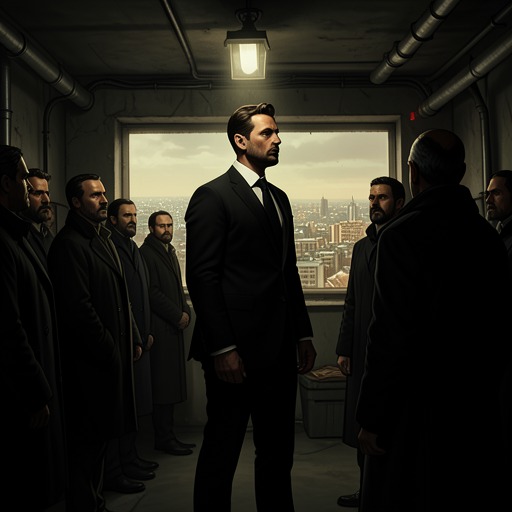
The Dark Knight Returns
This flow traces Bruce Wayne / Batman from exhausted retirement through renewed purpose to a transformed legacy.
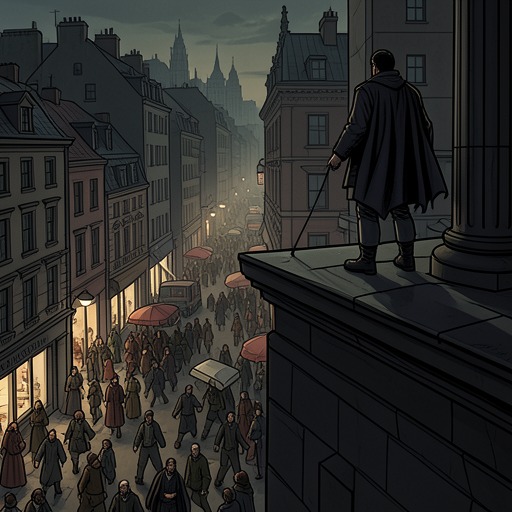
Gotham City’s Collapse and Recovery
This flow follows Gotham City from social decay and gang rule through blackout, emergency rule, and popular self-recovery.
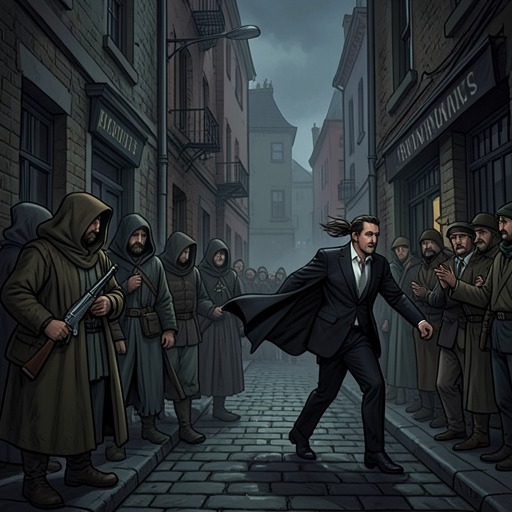
Batman and the Mutant Gang
This flow traces the escalation from gang terror to Batman’s tactical victory and the gang’s later transformation.
